
How to Choose the Best Sports Bikini for an Active Woman

Date
October, 6th 2026
Author
Roidal
Tags
A sports bikini for women goes far beyond bright colours or a tight cut. It is a garment engineered from the textile up to respond to real movement: strokes, jumps, turns, waves. If you have ever lost your top at the worst possible moment or come out of the water with the fabric completely stretched out, you know exactly what we mean.
At Roidal we have spent more than 40 years designing and manufacturing women’s swimwear in Spain. What that time has taught us is that choosing a sports bikini means understanding what happens to the fabric, the structure and the fit when the body really moves. In this guide we break down the criteria that truly matter so you can make an informed decision.
Sports bikini for women: why performance starts with the design
The swimwear market offers countless attractive models. But not all of them are designed to withstand the wear and tear of real physical activity. The difference between a leisure bikini and a fitness bikini for women starts with the fabric and ends with the architecture of each piece.
A seasonal model can look fantastic in a photograph and give way after ten minutes of swimming. The fabric loses its shape, the top rides up, the bottom shifts. None of this happens when the garment is built with the right materials and pattern.
The three factors that determine whether a bikini is truly sporty are: support, fabric behaviour and fit stability during movement. We analyse them one by one below.
To guide you according to the type of activity and your body shape, you can also read our guide on how to choose a bikini, where we approach this topic from a broader angle.
Chest support: the key to any sports swim top
Support is the criterion that raises the most questions and the one that makes the biggest difference to the wearing experience. A sports swim top that does not support well turns any activity into a source of constant tension.
What builds real support
Support does not depend on a single factor, but on the sum of several that work in a coordinated way.
The underbust band is the structural base of the top. A well-designed band distributes tension horizontally and anchors the top to the body, preventing it from riding up during movement. The wider and firmer the band, the greater the stability it offers.
The straps affect both support and comfort. Adjustable straps let you adapt the fit to each body. Wide, fixed or cross-back straps distribute the load better and reduce pressure on the shoulders during long sessions.
The cup and inner lining make the difference between a top that shapes and one that simply compresses. A lining cut and sewn with precision follows the shape of the chest without shifting. Some cups include a minimal structure that adds shape without adding stiffness.
Tension distribution is perhaps the least intuitive concept, but one of the most decisive. In a well-built top, tension does not fall on a single point such as the side ties or the neck straps, but is spread across the entire architecture of the piece. That is what prevents displacement under effort and explains why a bikini with chest support requires design, not just more fabric.
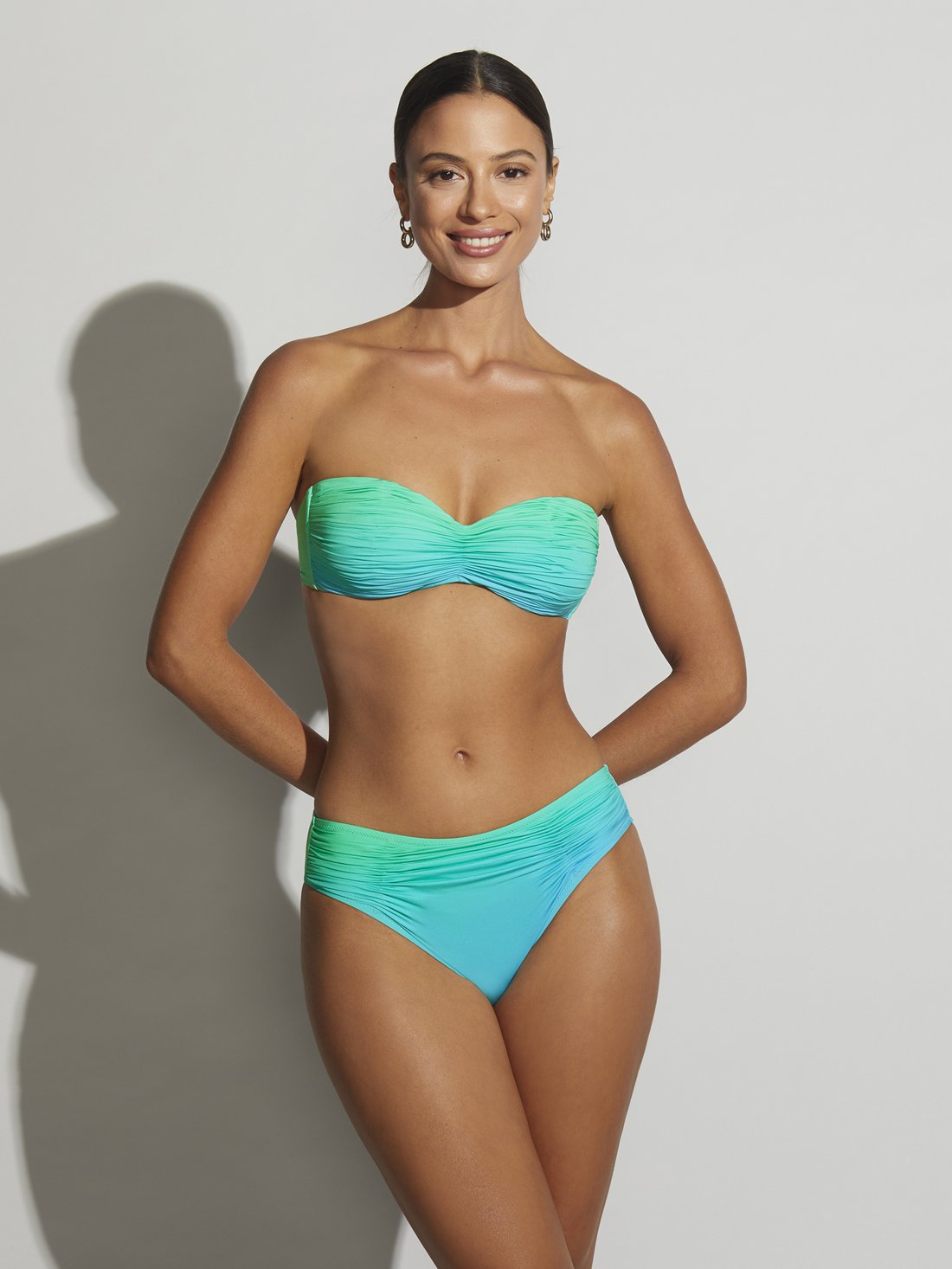
To understand how the shape of the top affects support according to your body and activity, our guide on bikini top styles explains in detail the differences between bandeau, halter, underwired, triangle and other styles.
Technical fabric: what sets a swimming bikini apart from the rest
The fabric is where it is decided whether a bikini lasts over time or starts to deteriorate in the first weeks of use. This is especially relevant in a swimming bikini, because continuous contact with water, chlorine, salt and sun accelerates any weakness in the material.
Chemical and environmental resistance
High-end technical fabrics, such as the Italian ones Roidal uses in its collections, are formulated to resist the main agents that degrade conventional swimwear.
Chlorine resistance: Pool chlorine is one of the greatest enemies of synthetic fibres. An unprepared fabric loses colour, elasticity and shape with continued use. High-end fabrics are designed to keep their properties with greater durability against regular exposure.
Salt and sun resistance: Salt water combined with UV radiation also degrades the fabric. Quality technical fabrics can offer UV protection and greater resistance to salt, features that help preserve the garment for longer.
Quick drying: A technical fabric releases water far more efficiently than a conventional one. This reduces weight while it is used in the water and speeds up drying afterwards.
Elasticity and recovery
Perhaps the least visible yet most decisive aspect for performance is fabric recovery, that is, its ability to return to its original shape after stretching.
A fabric with good recovery keeps the fit throughout the whole session. One with poor recovery starts to give way and loses support as time goes on. This difference is especially noticeable in high-intensity activities or long sessions.
Proper care also extends the useful life of any technical fabric. You can check the correct steps in our guide on how to wash bikinis to avoid the most common mistakes that speed up deterioration.
Swimming, water fitness or surfing: what each activity asks of a sports bikini for women
Not all water activities demand the same from a garment. Understanding the differences helps you prioritise the selection criteria.
Recreational swimming
Recreational swimming, whether in a pool or open water, combines repetitive arm and leg movement with continuous immersion. The main requirements are chlorine resistance, stable support that does not interfere with your strokes and a seamless fit that will not rub at the repeated contact points.
A swimming bikini that meets these requirements does not need to be a competition model. Most women who swim regularly look for comfort, durability and freedom of movement.
Water fitness
Aquafitness and aqua gym add impact and multidirectional movement in the water. Chest support becomes more demanding here because the movements are sharper and in more directions.
For water fitness, tops with an underbust band, a lined cup and wide or cross-back straps offer the most suitable architecture. In this context, a fitness bikini for women with effective support depends on several elements working together, not just one.
Surfing and active beach
Surfing and active beach activities such as volleyball, paddling or kayaking pose a different demand: the garment must withstand the pull of moving water. A wave can exert considerable force on the fabric, and a bikini that is not well fitted simply does not stay in place.
In this context, ties and adjustable straps become important. The more fitted and anchored the top is, the better. For the bottom, cuts with less fabric on the sides tend to move less underwater than side-tie triangles with a loose bow.
A surf bikini for women aimed at active use also needs fabric with high recovery, because the waves and movement stretch it constantly and the fabric must respond without giving way.
The bottom in a sports bikini: fit, coverage and stability
The bottom gets less attention than the top, but its role in a sporting context is just as important.
A bottom that shifts, that slides down in the water or that loses coverage during certain movements is not suitable for active use. The key criteria are:
Leg fit: The elastics should sit flat and snug, without pressing or creating pockets of fabric that trap water and create drag.
Coverage by activity: For swimming, fuller cuts offer more comfort and less chafing. For surfing or fitness, a Brazilian or mid-rise cut can provide more freedom of movement without shifting.
Seam resistance: The points of greatest tension are the sides and the gusset. Flat or reinforced seams withstand repetitive movement and rubbing against surfaces such as boards or pool edges better.
How to know the bikini fits you well before using it
The best way to validate a sports bikini is the movement test. Looking in the mirror is not enough: you have to move.
Raise your arms above your head. If the top rides up or the straps tighten uncomfortably, the fit is not right for activities that involve that gesture.
Lean forward. If the top pulls away from the body or the neckline opens more than you would like, the cup is not well fitted to your body shape.
Do a small knee bend. If the bottom slides down or shifts, the fit at the waist or legs is not right.
Before buying, check our Roidal size guide to confirm you are choosing the correct size. The wrong size turns any good fabric and any good architecture into an uncomfortable experience.
Frequently asked questions
How long does a sports bikini last if used daily in a pool?
Durability depends on the fabric, how often it is used, chlorine exposure and the care afterwards. Rinsing the bikini with cold water after every swim and washing it by hand helps preserve the colour, elasticity and shape. Even so, there is no fixed lifespan: it is worth checking whether the fabric loses recovery or the seams show wear.
What is the difference between a sports swim top and a competition swimming top?
A sports swim top combines function and design: it offers support, resistance and freedom of movement, but it also cares about aesthetics and finish. A professional competition top is optimised exclusively for speed and hydrodynamics, at the expense of design and comfort. For most women who do recreational swimming, water fitness or surfing, the sports swim top is the most complete option.
How do I know which size to choose if I am between two sizes?
In a sporting context, it is better to choose the size that offers more support, as long as it does not compress or limit your breathing. The larger size may provide more comfort, but at the expense of stability during movement. Check our size guide and, if you are unsure between two, consider whether your main priority is support or freedom of movement.
Are Roidal bikinis suitable for swimming in a pool?
The Italian technical fabrics Roidal uses in its collections are formulated to resist chlorine, salt and UV radiation. They are not professional competition models, but high-end swimwear designed and manufactured in Spain for women who want a garment that combines performance, durability and design. They are a solid option for recreational swimming, water fitness and active beach use.
September, 29th 2026
Triangle Bikini: How to Wear It and Which Design to Choose for Your Figure
Previous Article