Beach kaftan for women: how to style it with elegance

Date
November, 12th 2026
Author
Roidal
Tags
Few garments capture the spirit of summer like a good beach kaftan. It covers with elegance, lets the skin breathe and turns a swim outfit into a look with character of its own. It is the piece you throw over your bikini on the way to the beach bar terrace and that, with the right accessories, also works for a casual dinner by the sea.
Making the most of it goes beyond simply putting it over any swimsuit. Some combinations elevate the outfit and others dull it. In this guide we go over how to choose and wear a long kaftan for women with the confidence of someone who has mastered beach style.
What a beach kaftan is: the beach tunic that has become essential
The kaftan is a garment of Eastern origin with centuries of history. In its current beach version it appears as a loose beach tunic, made in light fabrics such as chiffon, cotton or viscose, with a V or round neckline and wide sleeves that ease movement. Its loose, enveloping silhouette makes it a comfortable, cool and flattering option.
What has driven its popularity is its dual nature as functional beachwear and a fashion piece. Unlike the classic sarong, which requires some skill with the knot and can come undone in the wind, the kaftan goes on and off in seconds with a polished finish. And unlike a short cover-up, its length and volume add a touch of drama that flatters the drape and the movement.
There are several versions depending on the length: the short kaftan, which sits above the knee and feels more dynamic; the long kaftan, which reaches the ankles and projects a more sophisticated image; and the in-between versions, at mid-leg. Each length has its moment and its ideal combination, and choosing well between them is the first step to getting the look right.
How to choose a beach kaftan according to your silhouette
Before talking about combinations, the starting point is the silhouette. The kaftan is an inclusive garment, but there are details of patternmaking and length that flatter each body type more.
- Tall and slender silhouettes: the long kaftan with free movement is their best ally. Large prints, saturated colours and fabrics with a generous drape work well. They allow pronounced necklines and wide sleeves without losing proportion.
- Petite or shorter silhouettes: a knee-length or slightly above-the-knee cut balances the proportions without visually shortening the figure. Medium or small prints and vertical lines help to slim. It is best to avoid excessive flare at the hem.
- Silhouettes with curves at the hips or thighs: a kaftan with a side or front slit, that lets the leg show as you move, is flattering because it breaks up the visual mass of the fabric and adds lightness. In this type of look, a sarong works well as a base skirt under a shorter kaftan, adding layers and a play of proportions.
- Silhouettes with a fuller bust: moderate V necklines lengthen the neck and slim the torso. Batwing sleeves or dropped shoulders distribute the volume harmoniously.
If you are unsure between two sizes, go for the looser one: the extra fabric in a kaftan adds movement and intentional proportion, while one that is too tight loses its essence.
The best looks for combining a kaftan at the beach
This is where the kaftan shows its potential. Knowing what to combine it with makes the difference between a memorable outfit and one that goes unnoticed.
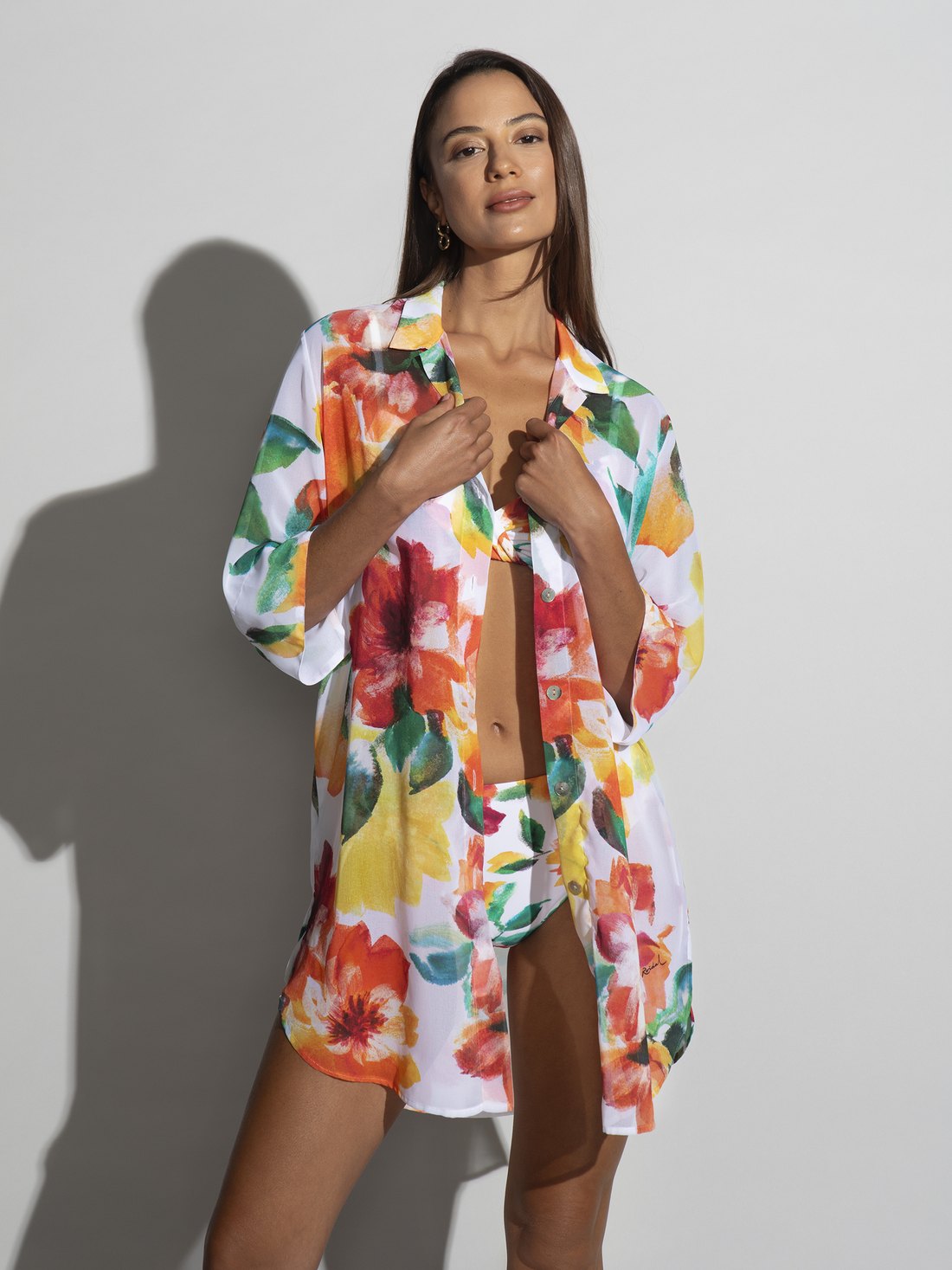
- With a bikini and nothing more. The most classic look. The kaftan acts as a semi-sheer cover-up and lets the swimwear show underneath. Choose a bikini with a print, colour or structure that deserves to be seen. A printed bikini under a solid-colour kaftan creates a balanced contrast. If the kaftan is printed, go for a plain-toned bikini that picks up one of the colours of the design. If you are still unsure which model to choose, this guide to choosing a bikini according to your style and needs helps to define the base of the outfit.
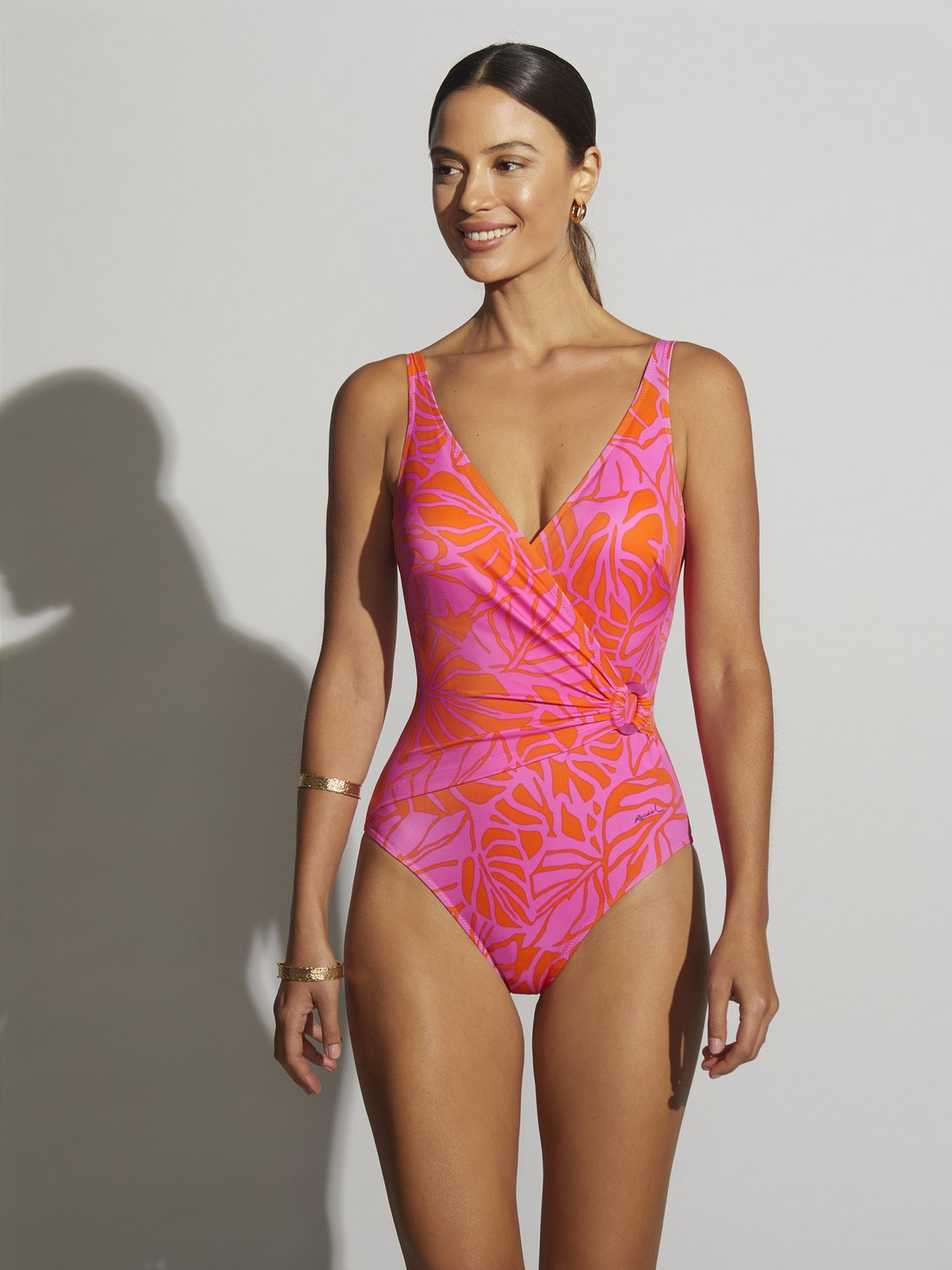
- With a one-piece swimsuit. This is the most elegant combination. A swimsuit with good patternmaking and a well-finished neckline lets you wear a more open or more sheer kaftan without losing comfort. A printed swimsuit under a white or ecru Ibiza kaftan is one of the most repeated beach-dress combinations every season.
- With flat sandals or low wedges. The footwear decides whether the kaftan reads as more casual or more dressed up. Flat sandals with thin straps, in gold, nude or white, are the natural option for the sand. For a walk around a coastal town or a restaurant, a mid-height espadrille wedge transforms the outfit without giving up comfort.
- With minimal but well-chosen accessories. The beach kaftan does not need much to shine. A wide-brimmed straw hat, sunglasses with a bold frame and a raffia bag complete the look. Adding gold or silver bracelets brings a polished finish without overloading.
Colour combinations for the long kaftan for women
Colour is one of the most decisive factors when combining the kaftan with the rest of the outfit. These are the combinations that work best in a beach or pool context:
| Kaftan colour | Ideal bikini or swimsuit | Accessories that enhance it |
|---|---|---|
| White or ecru | Floral or tropical print | Golds, raffia, straw hat |
| Navy or cobalt blue | Plain white, coral or sand | Silvers, white sunglasses |
| Multicolour print | A single colour from the print’s palette | Neutral accessories, nude sandals |
| Bottle or emerald green | Dusty pink, coral or beige | Golds, dark straw hat |
| Orange or terracotta | Navy, turquoise or white | Rope, raffia, bronze |
A simple rule: when the kaftan has its own visual prominence, the swimwear acts as a discreet base. If the bikini or swimsuit is the star piece, the kaftan plays a supporting role without competing. Playing with that balance is what defines a well-built look.
The Ibiza kaftan and the boho beach dress: how to wear them without overdoing it
The Ibiza kaftan is perhaps the most recognisable variant. It is characterised by its light fabric, generally in white or natural tones, with embroidery, lace or artisanal details on the neckline, the hem or the sleeves. It evokes the Mediterranean spirit of the islands and has a very marked personality.
To wear it without overloading, the key is to let the kaftan speak for itself. A simple bikini underneath, flat strappy sandals and little else. The embroidery already provides enough visual detail, so the rest of the elements are best kept neutral. Adding ethnic necklaces or very elaborate bags can take the spotlight away from the main piece.
This type of boho beach dress goes well with brown or camel leather accessories, which add an earthy touch coherent with the Ibiza aesthetic. It is best not to mix too many natural fabrics at once: raffia, hemp, straw and linen in the same outfit compete with each other. The ideal is to choose two at most and let the kaftan be the visual reference of the look.
The sarong kaftan: a freer, more versatile alternative
The sarong kaftan, that midpoint between the traditional sarong and the kaftan, deserves attention of its own. It is a piece of wide, light fabric that can be worn in several ways: as a wrap skirt, as an improvised dress or open as a cape over the swimwear. Its advantage is adaptability; its challenge, mastering a minimum of tying technique.
For those who prefer the comfort of the kaftan without giving up the free spirit of the sarong, there are hybrid models: kaftan-shaped garments made in sarong fabric, light and almost sheer, that move with the wind and follow the silhouette without defining it. It works especially well over a floral swimsuit or any piece with a botanical print, since the transparency of the fabric hints at the pattern of the garment underneath. The choice of fabric is decisive in this case; if you want to go deeper into materials, this guide to types of fabrics for swimwear helps to understand what to look for in each type of piece.
When to wear the kaftan beyond the beach
One of the great advantages of the kaftan is its ability to transition. With the right accessories, a well-chosen beach tunic works in very different contexts.
- At the beach bar or hotel terrace: a mid-length or maxi kaftan, sandals with a bit of heel, statement earrings and a clutch. With that you have a summer afternoon look sorted.
- At a market or coastal town: a short or mid-leg kaftan, with espadrilles or flat sandals, a straw hat and a large fabric bag. Cool, practical and full of personality.
- At a casual dinner by the sea: a long kaftan in a fabric with more drape, such as silk, satin or viscose, with wedge sandals, large hoop earrings and a slim chain bag lifts the outfit to a register very close to that of a summer dress.
The key in all these cases is knowing the limits of the kaftan you have. One in thick cotton with a bold print has a lower ceiling of elegance than one in chiffon in a solid colour. Identifying that ceiling and working within it is what refines beach style.
Final tips for getting the beach kaftan right
Choosing and combining a beach kaftan for women is simple once you are clear on a few principles. The fabric should be light and breathable, the length should keep proportion with your height, and the print or colour of the kaftan should dialogue with the rest of the outfit rather than compete with it.
The swimsuit you wear underneath is not a minor detail: it is half of the look. A bikini or swimsuit with good construction, careful patternmaking and materials that withstand real use in the sea and sun makes a visible difference even under the kaftan’s fabric. Betting on pieces that do not lose their shape, that keep their colour and that genuinely flatter is a smart investment for the summer wardrobe.
And, above all, the kaftan should make you feel comfortable. The most authentic style always starts from that base.
November, 3rd 2026
Tummy-control swimsuits: a guide to choosing the right one and looking your best
Previous Article