Beach Cover-Ups: What They Are and How to Combine Them with Your Swimwear
Date
September, 15th 2026
Author
Roidal
Tags
The beach cover-up is one of the most versatile pieces for completing a swimwear look. Its loose cut, the lightness of the fabric and how easily it layers over a bikini or swimsuit let you gain coverage without giving up a polished silhouette. At Roidal we design every cover-up to work with the colour, print and construction of the swimsuit, not as an isolated add-on.
What a beach cover-up is and why you need one this summer
A beach cover-up is a light coverage piece worn over a swimsuit or bikini. It can have a straight, A-line or semi-structured cut, with side slits, sleeves, straps or an open neckline. The choice of cut and fabric determines its drape, its transparency and freedom of movement; that is why it is worth assessing the piece as part of the complete look.
Unlike a sarong, whose shape depends on how it is tied, the cover-up keeps a defined structure thanks to its pattern making. Compared with a beach dress, it usually offers a lighter, more open construction. Chiffons, openwork fabrics, fine knits and light crepes allow different levels of coverage and movement. To better understand the difference between the two pieces, see our guide on what a sarong is and how to choose it.
A beach cover-up for women provides coverage on the shoulders, neckline and arms, but it does not replace a broad-spectrum sunscreen nor guarantee UV protection unless the fabric has a specific UPF certification. As a leading brand and reference in Spain and Europe in women’s swimwear, at Roidal we work these pieces with the same criteria of pattern making, colour coordination and finish that we apply to our Made in Spain swimwear.
Types of beach cover-ups by style
Not all beach cover-ups serve the same purpose. The length, the volume, the sleeve, the opening and the density of the fabric change both the coverage and the way the piece follows the body.
- Long cover-up: reaches the knee or below and offers greater coverage. Straight cuts create a cleaner line; A-line shapes add more movement. It is a suitable option for going from the beach to a terrace or a stroll without changing your whole look.
- Short or mid-length cover-up: ends at the hip or thigh and leaves the swimsuit more visible. It is practical when you alternate swims, walks and activities on the sand, because it adds coverage without piling on too much fabric.
- Hooded cover-up: adds a light layer around the head and neck and can be comfortable in breezy spots. It should not be considered certified sun protection if the fabric does not state a UPF factor.
- Cover-up with embroidery or graphic details: concentrates the visual weight on finishes, openwork, fringes or prints. It is best combined with a plain swimsuit or a coordinated palette to avoid competing focal points.
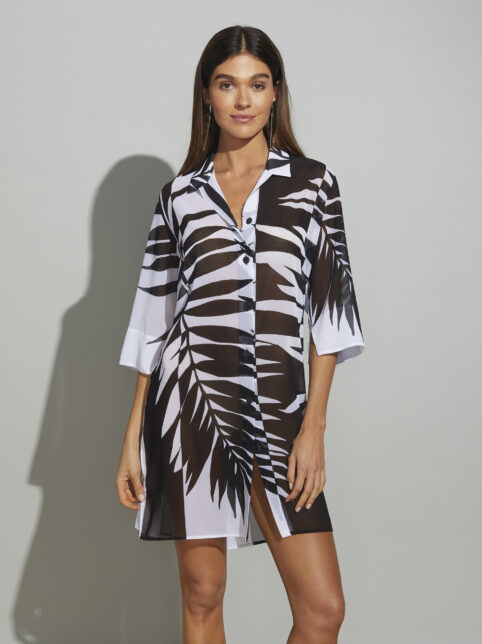
- White beach cover-ups: act as a neutral, luminous base. Their final effect depends on the density and the weave: a fine chiffon offers more transparency, while a compact or embroidered fabric provides greater visual coverage.
Before choosing, think about the level of coverage, the type of activity and the swimsuit you are going to combine it with. Those three criteria are more useful than choosing on trend alone.
How to combine beach cover-ups with your swimwear
To combine beach cover-ups with swimwear, look at three elements: proportion, colour and visual weight. A piece can echo tones from the bikini or swimsuit, create a controlled contrast or introduce texture, but the look should keep a clear focal point.
Combining cover-ups with printed bikinis
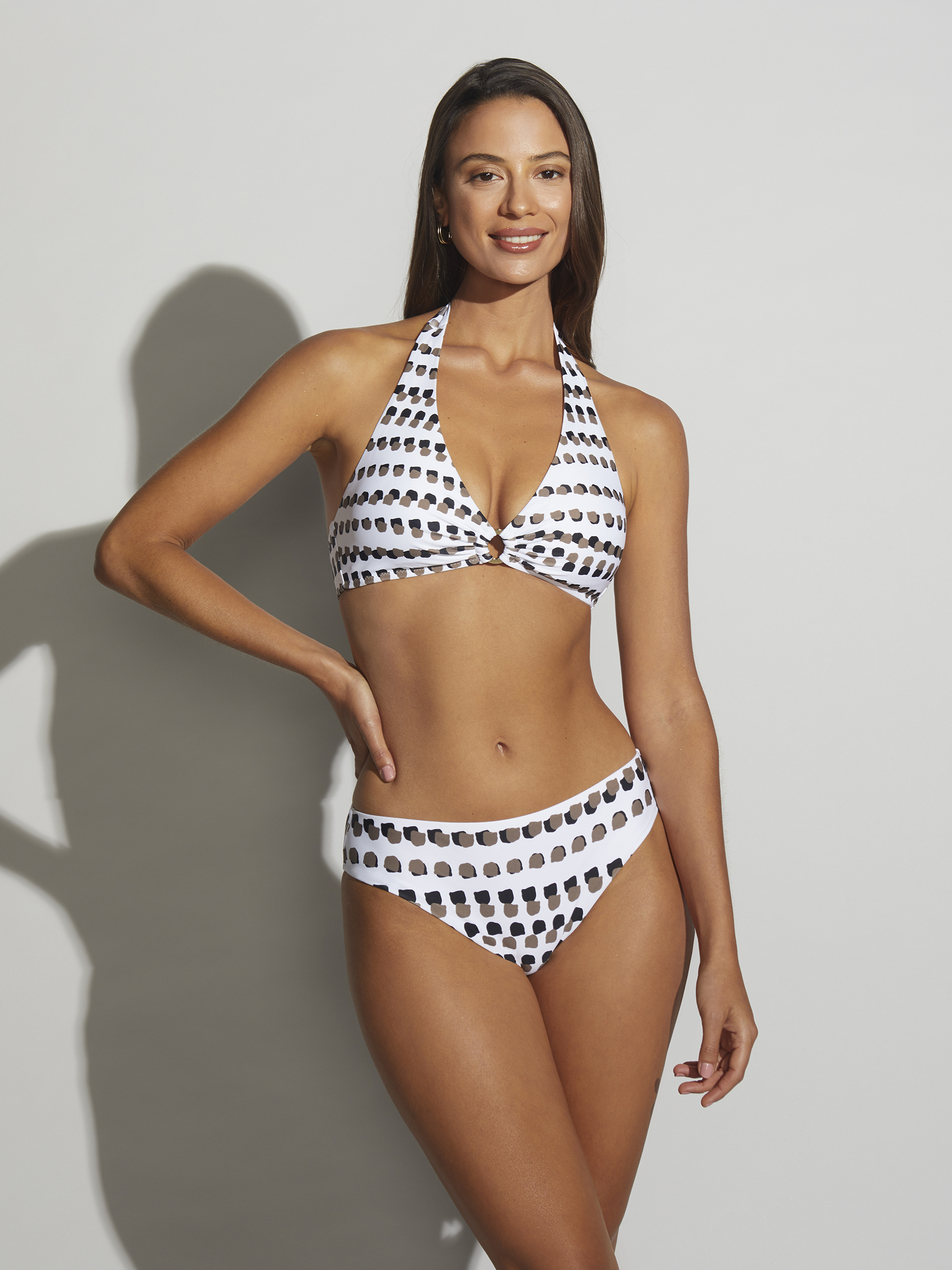
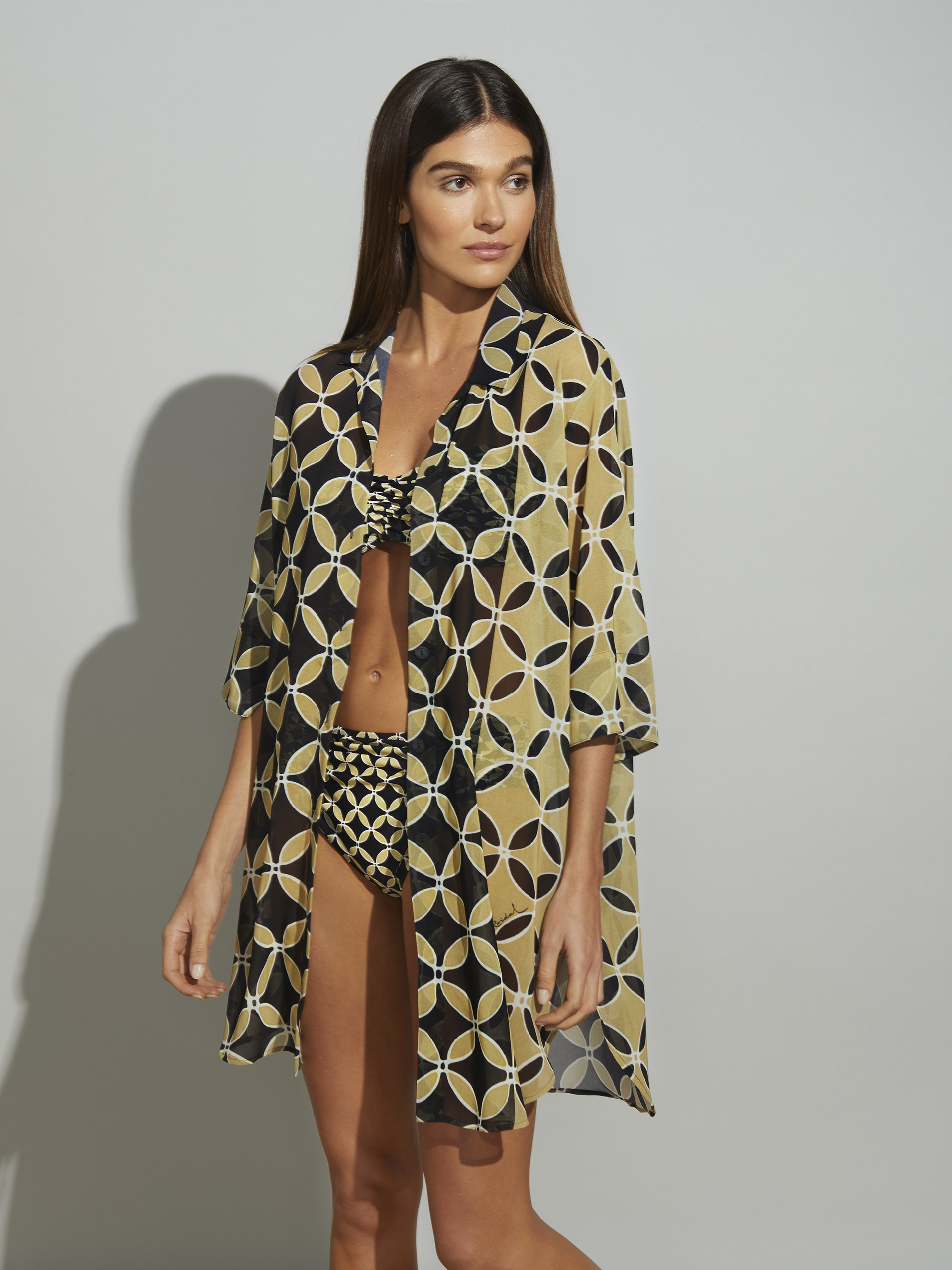
If you choose a printed bikini, a plain cover-up in white, ecru or one of the print’s secondary tones helps tidy up the look. You can also wear it open to keep the bikini pattern visible and preserve a lighter reading.
If the cover-up carries the print, a plain bikini can pick up one of its main or secondary colours. The two tones do not need to be identical: it is enough that they share a colour temperature or level of saturation for the look to feel coherent.
Combining cover-ups with swimsuits
The swimsuit creates a continuous visual surface, so it takes cover-ups with more texture or movement. A long, fluid design can contrast with a swimsuit of clean lines. If the neckline is strapless or asymmetric, an open, sleeveless or thin-strap cover-up lets that construction keep the spotlight.
Plain swimsuits make it easy to combine with embroidered, openwork or printed cover-ups. In that case, it is a good idea to repeat one tone of the swimsuit in some detail of the cover-up to connect both pieces without making the look uniform.
Style tip: if you wear a long, open cover-up, a flat sandal with clean lines keeps the look light and avoids adding visual volume at the bottom.
Coordinating colours between the cover-up and the swimsuit or bikini
The monochromatic combination is a safe solution: cover-up and swimsuit share the same colour family, even if they use different intensities. A navy bikini with a sky-blue or white cover-up creates continuity without the pieces looking identical.
Another option is tonal contrast. A coral, fuchsia or emerald-green bikini gains visual clarity next to a white or ecru cover-up. White beach cover-ups work especially well when you want to balance saturated colours.
When and where to wear the beach cover-up
The cover-up is not only for the water’s edge. Its versatility makes it a piece for many contexts throughout the beach day.
- At the shore: the transition from the towel to the water is the most common moment. The cover-up protects while you walk, and comes off when you get into the sea.
- At the beach bar or terrace: a long cover-up and a pair of sandals are enough to sit down for lunch without going back to the hotel to change.
- On the promenade: the cover-up with some shorts or light linen trousers can easily pass as a casual evening look in coastal destinations.
- On a boat: the sea breeze makes the cover-up’s light fabrics the most comfortable and elegant option at the same time.
This versatility depends on the quality of the pattern, the seams and the fabric recovery. To assess a piece, check the regularity of the stitching, the stability of the edges, the symmetry and the care instructions on the label.
How to assess the quality of beach cover-ups for women
The quality of a cover-up shows in the drape, the fabric recovery, the stability of the seams and the cleanliness of the finishes. A light material does not have to be fragile: the composition, the weight, the type of weave and the making determine how it responds to moisture, rubbing and washing.
At Roidal we apply to beachwear the same design criteria as to bikinis and swimsuits: in-house pattern making, coordination between pieces and attention to seams, finishes and drape. If you want to go deeper into composition, elasticity and durability, see our guide on types of fabrics for swimwear.
Care tip: always follow the label for composition and washing. As a general rule, avoid wringing light fabrics and intense heat; remove excess water with gentle pressure and dry the piece without straining seams or embroidery.
Quick guide to choosing your beach cover-up by silhouette
There is no single valid cut for every body. The following table summarises common visual effects of the cut and can serve as guidance, always behind the real fit and each person’s comfort:
| Silhouette | Recommended cut | Flattering detail |
|---|---|---|
| H (straight) figure | Cover-up with flare or embroidery | Adds volume and visual curves |
| Triangle figure (wider hips) | Long cover-up with a straight drape | Balances proportions visually |
| Inverted triangle figure (wider shoulders) | Sleeveless cover-up with a fluid cut | Softens the upper area and lengthens the figure |
| Rounded (curvy) figure | Semi-structured, mid-length cover-up | Defines the silhouette without clinging |
| Hourglass figure | Practically every cut | Cover-ups slightly fitted at the waist enhance the proportion |
These guidelines are not fixed rules. The right piece is the one that lets you move comfortably, keeps its drape and matches the level of coverage you are looking for.
Why white beach cover-ups are a timeless staple
White beach cover-ups stay season after season because they bring light and neutrality. They go with a wide range of swimsuits, although the result changes with the undertone of the white, the transparency and the texture of the fabric.
A white cover-up in fine chiffon lets the bikini colour show through; a more compact fabric creates a more defined visual layer. To pack it, fold it along the seams and avoid compressing embroidery, appliqus or fibres the label flags as prone to creasing.
White also lets the print, the neckline or the construction of the swimsuit hold the attention of the look.
If you are after a first, easy-to-coordinate cover-up, white, ecru or a neutral close to your usual palette are versatile options.